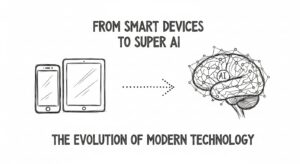
Introduction to the Digital Age
Technology didn’t just knock on our door—it moved in, rearranged the furniture, and made itself at home. From the phones in our pockets to algorithms quietly shaping our decisions, modern technology has become inseparable from daily life. But how did we get here? And where exactly are we headed?
What Do We Mean by Modern Technology?
Modern technology refers to the digital tools, systems, and innovations that define contemporary life. Think smartphones, cloud computing, artificial intelligence, smart homes, and now, the concept of Super AI. It’s not just about gadgets—it’s about how these tools reshape how we live, work, and think.
Why Technology Is Evolving Faster Than Ever
The pace of change today feels like a sprint on a treadmill that keeps speeding up. Advances build on each other, global connectivity fuels collaboration, and data acts like rocket fuel. Innovation no longer moves in straight lines—it explodes outward.
The Early Days of Digital Transformation
Before touchscreens and voice assistants, technology had a much humbler vibe.
From Analog to Digital
The shift from analog to digital was like switching from handwritten letters to instant messages. Information became faster to process, easier to store, and simpler to share. This transition established the groundwork for everything that came after.
The Rise of Personal Computers
Personal computers turned technology into something personal. No longer confined to labs or corporations, computing power landed on desks and eventually in homes, empowering individuals to create, calculate, and communicate.
The Internet Revolution
If computers were the brain, the internet became the nervous system.
Birth of the World Wide Web
The World Wide Web transformed isolated machines into a global network. Suddenly, knowledge was searchable, businesses went online, and communication ignored borders.
How Connectivity Changed Everything
Email replaced letters. E-commerce replaced shopping trips. Social media replaced, well… silence. The internet didn’t just connect devices—it connected people.
The Smartphone Era
Then came the device that glued it all together.
Smart Devices Become Everyday Essentials
Smartphones put a supercomputer in your pocket. Camera, GPS, music player, wallet, office—it all merged into one glowing rectangle.
Apps, Ecosystems, and Mobile-First Living
Apps turned phones into personalized toolkits. Entire ecosystems formed around mobile experiences, making life faster, smoother, and sometimes a little too addictive.
The Explosion of Smart Devices
Phones weren’t enough. Everything had to get smart.
Internet of Things (IoT) Explained
IoT refers to everyday objects connected to the internet—thermostats, fridges, watches, even light bulbs. These devices talk to each other, often without us noticing.
Smart Homes, Wearables, and Cities
From fitness trackers monitoring heartbeats to cities optimizing traffic flow, smart devices quietly optimize life behind the scenes.
Cloud Computing and Big Data
Where does all this information live? In the cloud.
Storing the World in the Cloud
Cloud computing enables us to view and store data remotely from any location. No more bulky hard drives—just seamless access on demand.
Data as the New Oil
Data fuels modern technology. Every click, swipe, and search feeds systems that learn, predict, and personalize. It’s powerful—and a little scary.
Artificial Intelligence Enters the Scene
This is where technology starts to feel alive.
What Is Artificial Intelligence?
Artificial Intelligence (AI) enables machines to mimic human intelligence—learning, reasoning, and problem-solving without constant instructions.
Machine Learning vs Deep Learning
Machine learning allows systems to learn from data. Deep learning goes further, using neural networks inspired by the human brain. Think of it as teaching machines not just facts, but intuition.
From Narrow AI to Super AI
AI isn’t one-size-fits-all.
The Different Types of AI
Narrow AI handles specific tasks—like voice assistants or recommendation engines. General AI aims to match human intelligence. Super AI? That’s intelligence beyond us.
What Is Super AI and Why It Matters
Super AI could outperform humans in nearly every field. It promises breakthroughs—but also raises questions about control, safety, and our role in the future.
AI in Everyday Life
You’re already using AI more than you think.
AI in Healthcare, Finance, and Education
AI helps doctors detect diseases, banks prevent fraud, and students learn at their own pace. It’s like having a tireless assistant everywhere.
Personalized Experiences Everywhere
From Netflix recommendations to smart ads, AI tailors experiences to individual preferences—sometimes eerily well.
Automation and the Future of Work
Work is changing fast.
Robots, Algorithms, and Jobs
Automation replaces repetitive tasks, boosting efficiency but disrupting traditional roles. Some jobs disappear, new ones emerge.
Reskilling for the AI Age
The future belongs to those who adapt. Creativity, emotional intelligence, and critical thinking become the new superpowers.
Ethical Challenges and Risks
With great power comes… complicated debates.
Privacy, Bias, and Control
AI systems can inherit bias, invade privacy, or make decisions we don’t fully understand. Guardrails matter.
Can We Trust Super AI?
The big question isn’t whether we can build it—but whether we can control it responsibly.
Human–AI Collaboration
It’s not humans vs machines. It’s humans with machines.
Augmented Intelligence
AI enhances human abilities rather than replacing them. Think co-pilots, not overlords.
Humans and Machines as Teammates
When humans provide creativity and ethics, and AI provides speed and scale, the results can be extraordinary.
The Road Ahead
The story isn’t over—it’s just getting interesting.
Emerging Technologies to Watch
Quantum computing, brain–computer interfaces, and advanced robotics are waiting in the wings.
A Glimpse Into the Next Decade
Technology will feel more intuitive, more immersive, and more intertwined with human life than ever before.
Conclusion
From Smart Devices to Super AI—A Defining Journey
The evolution from simple smart devices to the possibility of Super AI marks one of humanity’s most defining journeys. Technology has gone from being a tool we use to a partner we collaborate with. The challenge ahead isn’t just innovation—it’s wisdom.
FAQs
What is the difference between AI and Super AI?
AI performs specific or general tasks, while Super AI surpasses human intelligence across all domains.
Are smart devices part of artificial intelligence?
Many smart devices use AI, but not all smart devices are intelligent on their own.
Will AI replace human jobs completely?
AI will change jobs, not eliminate all of them. New roles will emerge alongside automation.
Is Super AI dangerous?
It can be if unmanaged. Ethical design and regulation are critical.
How can individuals prepare for an AI-driven future?
By learning continuously, embracing technology, and developing uniquely human skills.